COMPLETED STUDY:
Research Details
TRACT Study
Full title
Transfusion and Treatment of Severe Anaemia in African Children
Study overview
Severe anaemia is a major cause of hospital admission and death among children in sub-Saharan Africa. It may result from malaria, bacterial infections, nutritional deficiencies, sickle cell disease and other inherited or acquired conditions.
Blood transfusion can be lifesaving, but blood supplies in many African hospitals are limited. At the time TRACT was designed, there was limited evidence to guide clinicians on which children required immediate transfusion, how much blood should be given and which treatments could improve recovery after discharge.
The TRACT Study evaluated several practical treatment strategies intended to reduce early deaths, hospital readmissions, recurrence of anaemia and longer-term illness.
Study objectives
The study aimed to:
- Determine whether children with uncomplicated severe anaemia required immediate blood transfusion.
- Compare higher and lower blood-transfusion volumes.
- Evaluate whether multivitamin and multimineral supplementation improved recovery after discharge.
- Determine whether cotrimoxazole prophylaxis reduced mortality and hospital readmission.
- Assess the safety of the different transfusion and post-discharge strategies.
- Examine haematological and nutritional recovery.
- Assess the cost-effectiveness of the different treatment strategies.
- Generate evidence to improve severe-anaemia treatment guidelines in African hospitals.
Study design
TRACT was a multicentre, open-label, Phase III randomised controlled trial. It used a factorial design that allowed several treatment questions to be evaluated simultaneously.
The study included three main randomised comparisons:
- Blood-transfusion timing and volume.
- Post-discharge nutritional supplementation.
- Post-discharge cotrimoxazole prophylaxis.
Participants were followed for six months after enrolment.
Study population
The trial enrolled children aged two months to 12 years who were admitted to hospital with severe anaemia, defined as a haemoglobin concentration below 6 g/dL.
Participants were divided into two clinical groups:
- Complicated severe anaemia: Children with severe anaemia accompanied by serious clinical features that required immediate transfusion.
- Uncomplicated severe anaemia: Children with haemoglobin between 4 and 6 g/dL who did not have signs of clinical severity.
A total of 3,199 children were enrolled between September 2014 and May 2017.
Study sites
The study was conducted at four hospitals in Uganda and Malawi:
- Mbale Regional Referral Hospital, Uganda
- Soroti Regional Referral Hospital, Uganda
- Mulago Hospital, Kampala, Uganda
- Queen Elizabeth Central Hospital, Blantyre, Malawi
The Mbale study team was led by Professor Peter Olupot-Olupot and worked closely with Mbale Regional Blood Bank and the wider TRACT research collaboration.
Transfusion interventions
Immediate transfusion versus clinical monitoring
Children with uncomplicated severe anaemia were randomly assigned to receive either:
- An immediate blood transfusion; or
- No immediate transfusion, with close clinical and haemoglobin monitoring.
Children in the monitoring group received a transfusion if their haemoglobin fell below 4 g/dL or if they developed signs of clinical severity.
Higher-volume versus lower-volume transfusion
Children allocated to immediate transfusion were also randomly assigned to receive either:
- Lower-volume transfusion: 20 mL/kg of whole blood or 10 mL/kg of packed red cells.
- Higher-volume transfusion: 30 mL/kg of whole blood or 15 mL/kg of packed red cells.
This comparison examined whether a larger initial transfusion would improve correction of anaemia, reduce repeat transfusions and lower mortality.
Post-discharge interventions
Nutritional supplementation
Children were randomly assigned to receive either:
- Enhanced multivitamin and multimineral supplementation containing iron and folate; or
- Standard iron and folate treatment.
The intervention was given for three months following hospital discharge. Children older than one year also received anti-helminthic treatment where appropriate.
Cotrimoxazole prophylaxis
Participants were also randomly assigned to receive either:
- Daily cotrimoxazole prophylaxis for three months; or
- No cotrimoxazole prophylaxis.
This comparison investigated whether preventing common bacterial and parasitic infections after discharge could reduce mortality and hospital readmission.
Study outcomes
The main outcomes included:
- Mortality within 28 days
- Mortality within six months
- Haemoglobin recovery
- Recurrence of severe anaemia
- Requirement for additional transfusions
- Length of hospital stay
- Hospital readmission
- Nutritional recovery
- Infectious complications
- Serious adverse events
- Transfusion-related complications
- Cost-effectiveness of the treatment strategies
Main findings
Timing of transfusion
Immediate transfusion did not significantly reduce 28-day or six-month mortality among children with uncomplicated severe anaemia compared with close monitoring and transfusion only when clinically indicated.
However, approximately half of the children initially managed without transfusion subsequently developed clinical severity or a further decline in haemoglobin and required transfusion.
The findings indicated that immediate transfusion can be safely avoided in some children with uncomplicated severe anaemia, provided that they are closely monitored and blood is readily available if their condition worsens.
Transfusion volume
Overall, there was no statistically significant difference in 28-day mortality between children who received 30 mL/kg and those who received 20 mL/kg of whole-blood equivalent.
However, an important difference was observed according to the child’s temperature at enrolment:
- Among children without fever, the higher 30 mL/kg volume was associated with lower mortality.
- Among children with fever, the higher volume was associated with increased mortality compared with 20 mL/kg.
These findings suggested that a single transfusion volume may not be appropriate for every child and that fever status should be considered when selecting the transfusion volume. Read the transfusion-volume results.
Nutritional supplementation
Enhanced multivitamin and multimineral supplementation did not improve six-month survival compared with standard iron and folate treatment.
Cotrimoxazole prophylaxis
Three months of cotrimoxazole prophylaxis did not significantly improve six-month survival compared with no prophylaxis.
The study nevertheless identified high levels of post-discharge illness and hospital readmission, demonstrating that children recovering from severe anaemia remain vulnerable after leaving hospital. Read the post-discharge treatment results.
Interpretation of the findings
TRACT demonstrated that children with uncomplicated severe anaemia do not always require an immediate transfusion. However, this approach depends on careful observation, repeated haemoglobin testing and rapid access to blood if the child’s condition deteriorates.
The trial also showed that transfusion volume should be individualised. Higher-volume transfusion may benefit children without fever but could be harmful to children who are febrile.
Neither enhanced nutritional supplementation nor routine cotrimoxazole prophylaxis improved survival, indicating that alternative interventions are required to reduce the high risk of illness and readmission after discharge.
Importance of the study
TRACT was one of the largest clinical trials examining childhood blood-transfusion practices in Africa. It provided high-quality evidence in an area where previous recommendations had largely been based on expert opinion and limited observational data.
The study’s findings are relevant to:
- Paediatric transfusion guidelines
- Emergency management of severe anaemia
- Use of scarce blood supplies
- Clinical monitoring of children not immediately transfused
- Selection of appropriate transfusion volumes
- Post-discharge care of vulnerable children
- Prevention of avoidable deaths and hospital readmissions
A subsequent expert group used the findings to develop a practical consensus algorithm for managing severe anaemia in African children. Read the TRACT transfusion-management consensus.
Study leadership and collaborating institutions
The Chief Investigator was Professor Kathryn Maitland of Imperial College London and the KEMRI-Wellcome Trust Research Programme.
The Mbale site was led by Professor Peter Olupot-Olupot. Other site investigators included Professor Sarah Kiguli, Professor Robert Opoka, Dr Charles Engoru and investigators from Uganda and Malawi.
Major collaborating organisations included:
- Imperial College London
- MRC Clinical Trials Unit at University College London
- KEMRI-Wellcome Trust Research Programme
- Mbale Regional Referral Hospital
- Makerere University and Mulago Hospital
- Soroti Regional Referral Hospital
- University of Malawi College of Medicine
- Malawi-Liverpool-Wellcome Trust Clinical Research Programme
- Uganda Blood Transfusion Service
- Malawi Blood Transfusion Service
- Mbale Regional Blood Bank
- Liverpool School of Tropical Medicine
- Amsterdam University Medical Centre
Sponsor and funding
The study was sponsored by Imperial College London.
It was funded by the UK Medical Research Council and the UK Department for International Development through their joint funding arrangements.
Ethical approval and consent
The study received ethical and regulatory approval from the relevant committees in the United Kingdom, Uganda and Malawi, including:
- Imperial College Research Ethics Committee: ICREC_13_1_11
- Makerere University School of Medicine Research and Ethics Committee: REC 2013-050
- University of Malawi College of Medicine Research and Ethics Committee: P.03/13/1365
- The Uganda National Counsil of Science of Technology
- The Uganda National Drug Authority
Written informed consent was obtained from parents or legal guardians. An approved two-stage consent process was used for children presenting with life-threatening emergencies where delaying treatment could have placed them at further risk.
Trial registration
The TRACT Study was registered as:
The registration was approved on 11 February 2013.
Study status
The TRACT Study is completed. Participant recruitment ended in May 2017, and the principal trial results were published in 2019.
Key publications
- TRACT study protocol – Trials
- Immediate transfusion in children with uncomplicated severe anaemia – New England Journal of Medicine
- Transfusion volume for children with severe anaemia – New England Journal of Medicine
- Cotrimoxazole and nutritional supplementation after discharge – The Lancet Global Health
Study Summary
TRACT Study – Transfusion and Treatment of Severe Anaemia in African Children
The TRACT Study investigated optimal treatment strategies for children with severe anaemia in Uganda and Malawi. The Phase III trial enrolled 3,199 children at four hospitals, including Mbale Regional Referral Hospital. It evaluated when transfusions should be given, appropriate transfusion volumes, nutritional supplementation and cotrimoxazole after discharge. The study found that immediate transfusion could be safely avoided in some children with uncomplicated severe anaemia when close monitoring and rapid access to blood were available. It also showed that transfusion volume may need to consider fever status, while post-discharge supplementation and cotrimoxazole did not improve survival.
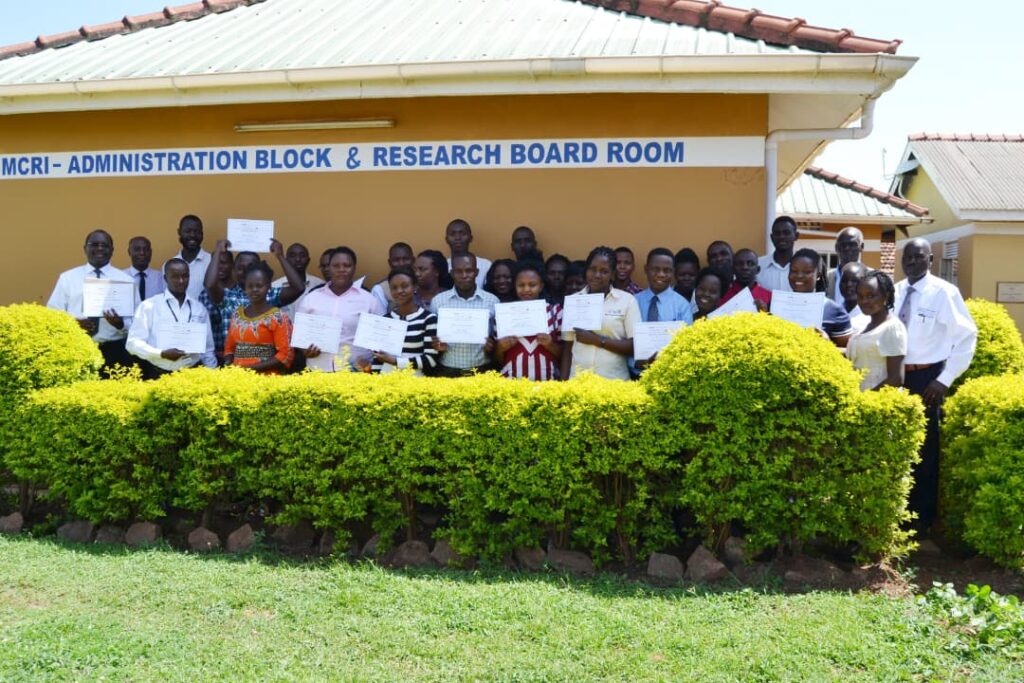
TRACT Closure Certificates Award Group Photo, September 2018